
Disclosure: This guide is published by Mariden Resort. While we've aimed for accuracy, we encourage you to research both areas for your trip.
⚠️ Important Safety Notice
Mariden Resort and Homestay Siargao accepts no liability for any injury, accident, or fatality arising from diving or snorkeling activities in Siargao. Water-based activities carry inherent risks, including strong and unpredictable sea currents that have resulted in recorded fatalities at certain sites around the island.
You must use a guide accredited by the local tourism office before entering the water at any dive or snorkeling site. Unguided diving and snorkeling in areas with strong currents is dangerous and strongly discouraged. Always verify that your guide or dive operator holds valid accreditation from the Siargao/General Luna tourism office before booking. If in doubt, ask to see their credentials.
Most visitors come to Siargao for surf. The underwater world is what keeps a certain type of traveler coming back. The reefs here are in genuinely good shape: sea turtles appear on most dives, whitetip and blacktip reef sharks patrol Shark Point on a reliable basis, and the Blue Cathedral is one of the more striking cavern dives in the Philippines. You don't need a certification to get into the water; the island-hop snorkel circuit alone puts you above coral and fish for a few hundred pesos. This guide covers both: what's actually under the surface, how to access it, and what it costs.
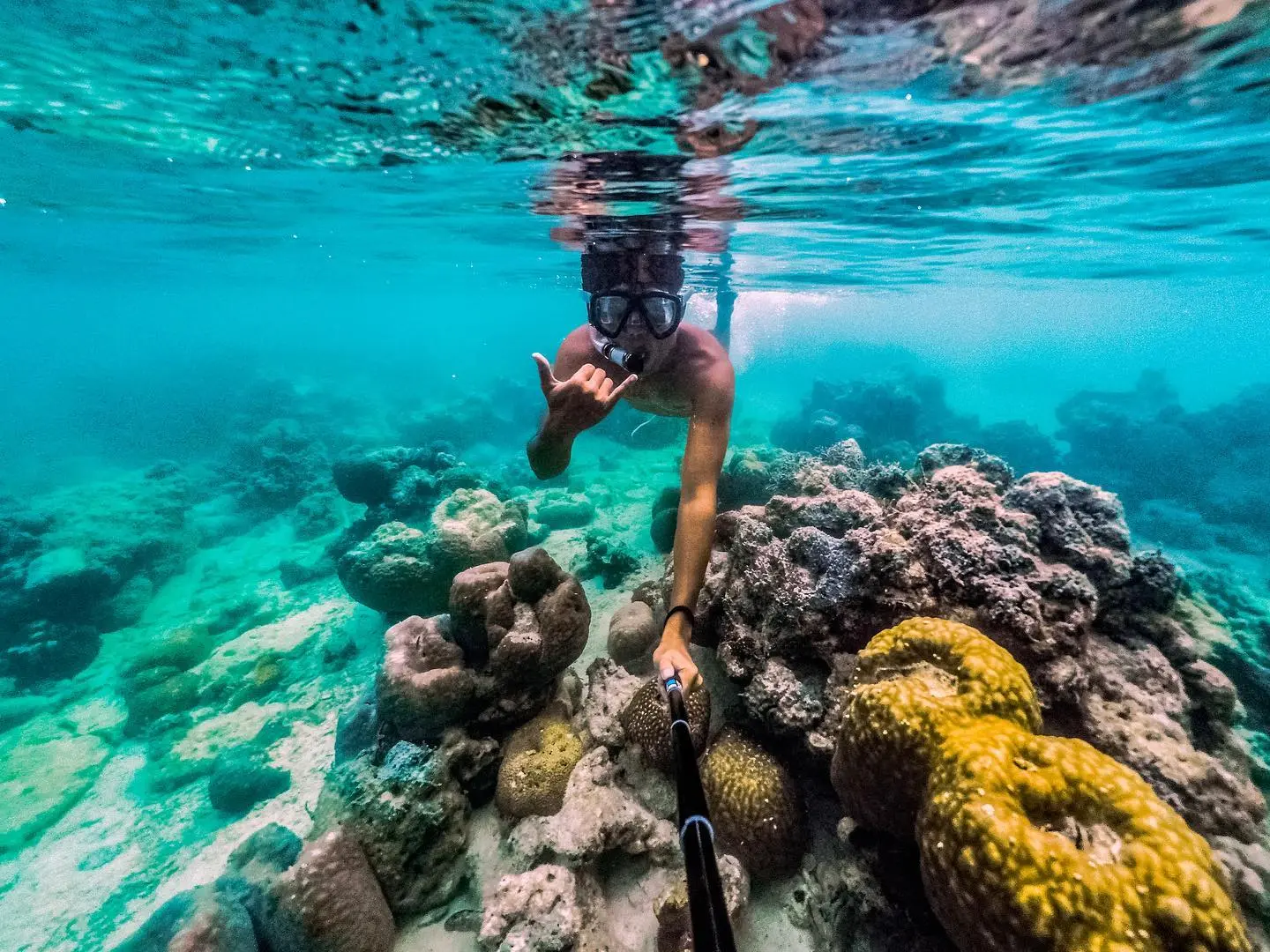
Image courtesy of Aristotle Manabat
Siargao Underwater: Why It's Underrated
Siargao sits at the edge of the Philippine Sea, with the deep Mindanao Trench lying just off its eastern coast. That geography shapes the diving: walls and drop-offs start close to shore, visibility regularly reaches 15–25 meters during the dry season, and the warm water (26–30°C year-round) means you can stay down without a wetsuit for several dives. Water temperature barely shifts between seasons; the main variable is surface conditions, not temperature below the thermocline.
Unlike Tubbataha or Apo Island, Siargao isn't famous for diving. That's mostly an advantage. The reefs are not heavily dived, the fish are not shy, and the handful of serious dive operators here keep group sizes small. There are around a dozen regularly dived spots, ranging from beginner-friendly coral gardens at 5–18 meters to the advanced Blue Cathedral cavern at 30–40 meters. The surf crowd keeps the underwater scene small enough to feel uncrowded even during peak season.
- Water temperature: 26–30°C (79–86°F) year-round
- Visibility (dry season): 15–25 meters
- Visibility (wet season): 5–15 meters, variable
- Depth range: 5m (shallow snorkel reefs) to 40m+ (Blue Cathedral)
- Wetsuit needed: 3mm optional; many divers go in a rash guard only
- Main dive hub: General Luna (west coast jump-off for most sites)
- Certification dives available: Yes; PADI Open Water and higher at Palaka Siargao Dive Center
Top Dive Sites Around Siargao
All sites below are accessed by speedboat from General Luna. Journey times are short; most sites are 10–30 minutes from the GL wharf. Dive shops handle transportation as part of the dive package.
Blue Cathedral
- Depth: 18–40m
- Difficulty: Advanced (Open Water minimum, Advanced recommended)
- Best for: Experienced divers, cavern photography, pelagic species
- What you'll see: Schools of jacks, trevally, barracuda, and eagle rays move through the cavern. The light filtering through the water from above turns the interior a deep, cathedral-like blue (the effect that gave the site its name). Stalactites line the ceiling; coral encrusts every surface.
- Note: The distance from shore and the skill required to navigate the cavern safely make this unsuitable for beginners. Confirm your certification level with the dive shop before booking.
Shark Point
- Depth: 10–30m (sloping reef transitions to wall)
- Difficulty: Intermediate (Open Water and above)
- Best for: Shark sightings, wall diving, reef fish diversity
- What you'll see: Whitetip and blacktip reef sharks cruise the drop-off regularly; this is the most reliable site for shark encounters around Siargao. Healthy coral coverage throughout the slope. Strong currents at depth are possible; check with your guide.
Daku Arch
- Depth: 10–20m
- Difficulty: All levels (Open Water and above)
- Best for: First dives at a named site, coral photography, schooling fish
- What you'll see: A submerged rock arch you can swim through, surrounded by hard and soft corals. Schools of jacks and snapper patrol the structure. The moderate depth and benign conditions make it a natural second dive or a comfortable first named-site dive for newly certified divers.
Casulian Reef
- Depth: 5–18m
- Difficulty: Beginner-friendly (all certification levels)
- Best for: Newly certified divers, turtle sightings, macro photography
- What you'll see: Well-preserved hard coral garden with excellent coverage. Green sea turtles are a near-daily sighting here; they rest on the reef and are accustomed to divers. Nudibranchs, ghost pipefish, and frogfish reward patient observers. A comfortable, relaxed dive with no strong currents.
Pilar Twin Rocks
- Depth: 15–25m
- Difficulty: Intermediate
- Best for: Schooling pelagics, current diving, experienced reef divers
- What you'll see: Twin rock formations create upwelling currents that attract larger pelagic species on good days: big schools of jacks, occasional eagle rays, and sometimes the resident whitetips from deeper water. Best dived during outgoing tides when current brings fish activity up to the rocks.
Also worth knowing: Puyo Reef and Seeco Reef are additional sites dived regularly by local operators; ask your dive shop about these depending on conditions and your certification level. Site availability varies with weather and sea state.
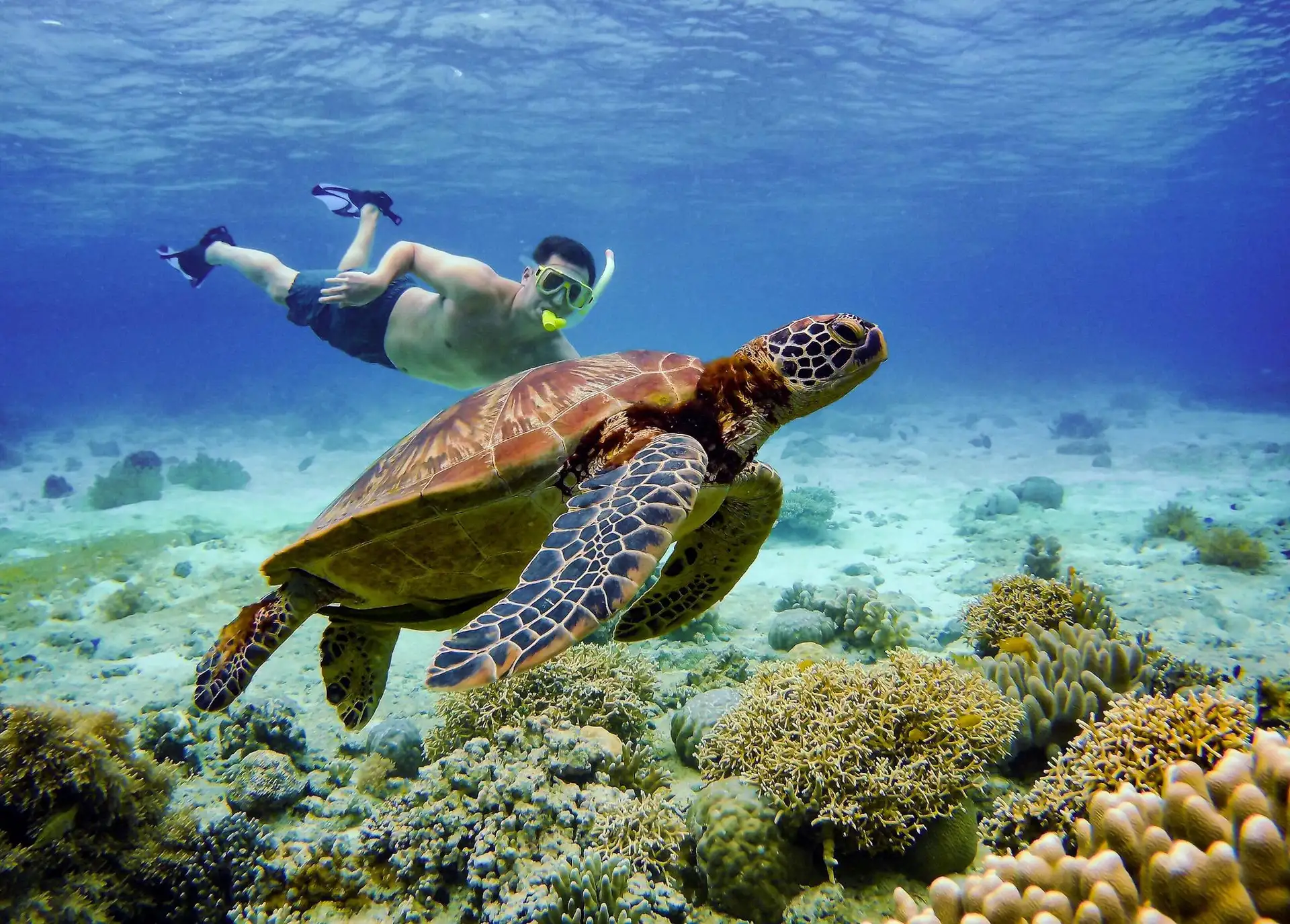
Image courtesy of Mcrich Travel
Best Snorkeling Spots in Siargao
You don't need a certification to see Siargao's marine life. Several spots are accessible by joining a standard island-hopping boat (₱500–₱800/person shared) or by wading in from shore. No boat rental needed for some spots near General Luna's coast.
Guyam Island
The most popular snorkeling stop in Siargao, included in almost every Tri-Island Tour from General Luna. Guyam Island is a tiny palm-fringed islet about 10–15 minutes by boat from GL wharf. Coral patches ring the island's edges, and tropical reef fish (parrotfish, surgeonfish, wrasse) are visible within snorkeling depth. Best snorkeling is on the eastern side of the island where coral coverage is densest. No entrance fee, but you arrive as part of a boat tour (₱500–₱800/person).
Naked Island
The most stripped-back stop on the island hop: a sandbar with no shade, no buildings, and a ring of coral around its edges. Snorkeling at Naked Island rewards those willing to wade in from the shallows; the coral starts close to shore and supports a variety of reef fish and occasionally sea turtles. Part of the same Tri-Island Tour as Guyam. Bring reef-safe sunscreen; there is no shade on the sandbar.
Malinao Beach (near General Luna)
A quiet stretch of coast near Secret Beach, accessible without a boat. The calm, sheltered water here is shallow enough to snorkel in, with patches of coral close to the rocky shoreline. A good option for an unplanned afternoon snorkel without committing to a full island-hop. Bring your own gear; no rentals on site.
Around Daku Island
Daku Island is the largest of the three islands on the island-hop and the only one with shade trees and a small store. The surrounding water is shallow and calm, with coral heads scattered along the shore. Less dramatic than Guyam's reef edge but suitable for calmer snorkeling, particularly for children or nervous swimmers. Included in the standard tri-island tour.
What about Sohoton Cove? Sohoton also has a form of "snorkeling": swimming with stingless jellyfish at Tojoman Lagoon. That experience is covered in the dedicated Sohoton Cove guide. The jellyfish sanctuary is best visited March–June and is reached by a full-day boat tour from Dapa Port, not a half-day island hop.
Marine Life Guide: What You'll Realistically See
The honest version: Siargao's underwater world rewards effort and timing. Here's what's reliably there versus what requires luck or specific conditions.
Almost Always (any season, any certified dive)
- Green sea turtles: Near-daily sightings at Casulian Reef and Daku Arch. They rest on the coral and treat divers as non-events. This is the one Siargao sighting that almost nobody misses.
- Reef fish (parrotfish, surgeonfish, wrasse, snapper, fusiliers): The reef fish population here is healthy and abundant. Casulian and Daku Arch have the densest concentrations.
- Hard and soft corals: Siargao's reefs are in good condition relative to much of the Philippines; branching and massive corals are visible at all sites.
Regularly (most dives, best dry season)
- Whitetip reef sharks: Most reliable at Shark Point. Whitetips are bottom-resting sharks; you'll often see them lying still on the sand between coral heads before they drift off. Not aggressive.
- Blacktip reef sharks: Also seen at Shark Point, usually in shallower water than whitetips. Slender, fast, and skittish; they circle and move on.
- Schools of jacks and trevally: All open-water sites attract these, particularly Blue Cathedral and Pilar Twin Rocks, where upwelling currents concentrate baitfish.
- Eagle rays: Spotted occasionally at the deeper sites; Blue Cathedral and Pilar Twin Rocks are the most likely locations. No guarantees, but sightings are frequent enough to be worth mentioning to your dive guide before the dive.
Macro life (requires a sharp-eyed guide)
- Nudibranchs: Casulian and the shallower reefs host a good variety of nudibranchs for macro photographers. Ask your guide to keep an eye out; they spot these far faster than divers unfamiliar with the sites.
- Ghost pipefish and frogfish: Present on most reef dives; frogfish sit motionless on coral and sponge and are easy to miss without guidance.
- Octopus: Commonly seen hunting in the late afternoon across all shallow reef sites.
Seasonal and rare
- Manta rays: Possible at Pilar Twin Rocks and Blue Cathedral during plankton-rich periods, typically April–June. Not reliable enough to plan a trip around, but a real sighting when conditions align.
- Whale sharks: Not found around Siargao. The closest whale shark encounter is Oslob in Cebu (several ferry and land-transfer hours away, and controversial for welfare reasons) or Donsol in Sorsogon (much further, wild encounters, season February–May). Don't travel to Siargao specifically to see whale sharks.
- Thresher sharks: Occasionally reported in deeper water off the eastern shelf, but not a targeted site here. Malapascua in Cebu is the established destination for thresher shark dives.
Dive Shops & Operators in Siargao
The dive scene in Siargao is small but professional. General Luna is the hub; all major operators are based there and run boats to sites within 10–30 minutes.
Palaka Siargao Dive Center
The longest-established and most visible dive operation on the island, located in General Luna. Palaka is a PADI 5-Star Dive Center and also offers full AIDA freediving courses, the only international freediving school on Siargao. Instruction is available in multiple languages. They operate a speedboat equipped with GPS, radio, and life jackets, and cover the full range of local sites from shallow beginner reefs to Blue Cathedral.
- PADI courses: Open Water, Advanced Open Water, Rescue Diver, Divemaster, and specialty courses
- Freediving: Full AIDA course range
- Fun dives: Minimum 2-dive packages; rates approximately ₱2,000–₱2,500 per dive (~$35–45 USD)
- Discover Scuba Diving (intro): Approximately ₱2,500–₱3,500 (~$45–62 USD) for non-certified beginners
- Equipment: Full rental gear included in dive packages
- Group size: Small groups; ask about private dive options for a quieter experience
Other Operators
Several smaller dive operations and guesthouse-affiliated shops in General Luna offer fun dives and introductory experiences. Standards vary; for first-time divers or advanced sites like Blue Cathedral, Palaka's track record and equipment are worth the slight premium. For a casual reef dive by certified divers, smaller operators are a fine choice. Always ask about guide experience with the specific site before booking.
Booking Tips
- Book the day before; morning dives (8–9 AM departures) get the best conditions and light
- Minimum 2-dive packages are standard; single-dive rates are higher per dive
- Equipment rental is included in most packages; confirm before agreeing to price
- For open-water certification courses (3–4 days), book at least 1–2 days in advance, especially peak season
- Tipping the boat crew and guide is not mandatory but appreciated; ₱200–₱500 (~$4–9 USD) per person is common for a half-day dive
Snorkel gear rental: Mask, fins, and snorkel can be rented from General Luna dive shops and some beach-side guesthouses for approximately ₱150–₱300 (~$3–5 USD) per day. If you plan to snorkel more than twice during your stay, bringing your own mask significantly improves the experience (fit and clarity).
Base camp 5 minutes from Siargao Airport
Mariden Resort is in Del Carmen, 5 minutes from the airport, 25 minutes from General Luna's dive shops and island-hop wharf. After a morning dive or snorkel trip, you're back at a pool and a real bed faster than most GL guesthouses. Rooms from ₱1,500/night (~$26 USD) with Starlink WiFi.
Book directly with code DIRECT10 for 10% off.
Explore Our RoomsBest Time to Dive in Siargao
The dry season (March–October) is the reliable window for diving. Within that, March through May is the standout: the northeast monsoon has passed, seas are calm, plankton levels drop and visibility is at its peak, and the surf season hasn't yet pushed visitor numbers (and dive boat demand) to their height.
Month-by-Month Visibility Guide
| Period | Conditions | Diving Verdict |
|---|---|---|
| March–May | Calm seas, peak visibility (20–25m), 27–29°C | Best of the year |
| June–August | Still good, occasional afternoon showers, 28–30°C | Excellent |
| September–October | Surf season begins; rougher east-coast seas; GL-side sites still diveable | Good (avoid east-facing sites) |
| November–February | Typhoon risk, rougher seas, reduced visibility (5–15m), stronger currents | Proceed with caution; check conditions daily |
Surf Season vs Dive Season
Siargao's peak surf season runs roughly September to November, when strong northeast swells make Cloud 9 fire. Those same swells can create surge and reduced visibility at east-facing dive sites. The west-coast sites near General Luna (the majority of named dive sites) are sheltered from northeast swell and remain diveable well into the surf season. If your trip overlaps with peak surf, prioritize GL-side sites and check conditions on the morning of your dive.
Currents, Safety & Accredited Guides: Read Before You Dive
Strong sea currents have caused fatalities at dive and snorkeling sites around Siargao. Certain sites, particularly those beyond the reef edge, around Pilar Twin Rocks, and at the mouth of Blue Cathedral, can run powerful rip-like currents during tidal changes, with little visible warning from the surface.
You are legally and practically required to use a guide accredited by the local tourism office at all dive and snorkeling sites. Accredited guides know which sites are dangerous on any given tide and sea state, and their instructions on site must be followed. Do not enter the water at any named dive or snorkeling site without one.
Before booking any dive or snorkel trip, ask your operator: "Is your guide registered and accredited with the General Luna / Siargao tourism office?" Reputable operators like Palaka Siargao Dive Center will answer yes without hesitation. If an operator is vague about guide credentials, find another operator. Mariden Resort accepts no liability for injuries or fatalities arising from water activities.
Beginner vs Advanced: Which Sites Suit You
Complete beginners (no certification)
You have two options without any certification: snorkeling (no training required, access the reef to 3–4 meters) or a Discover Scuba Diving (DSD) introductory dive conducted with a certified instructor in shallow, calm water. DSD dives at Palaka Siargao Dive Center typically go to Casulian Reef or a similar shallow site (5–12m) where conditions are forgiving. You do not receive a certification after a DSD, but you can log the dive in a PADI eLearning profile if you later pursue Open Water certification.
Newly certified (PADI Open Water or equivalent)
Your Open Water certification is valid to 18 meters. In practice on Siargao, that covers: Casulian Reef, Daku Arch, and the upper portions of Shark Point. All of these are appropriate for newly certified divers in calm conditions. Blue Cathedral and Pilar Twin Rocks push into Advanced Open Water territory; if you're within certification depth limits, you can dive the shallower sections of those sites, but confirm with your guide.
Advanced Open Water and above
The full range of sites is open to you, including Blue Cathedral to 40m and the deeper sections of Shark Point and Pilar Twin Rocks. Blue Cathedral is the site most worth upgrading for; it's genuinely unlike anything at shallower depths, and the cavern environment means a guide who knows the site well is essential. Consider completing your Advanced Open Water course here if you're 2–3 dives short; the local sites are a better classroom than a swimming pool.
Freedivers
Palaka Siargao Dive Center is the only AIDA-certified freediving operation on Siargao. For freedivers, the calm, warm, clear water in the dry season is excellent for depth training. The island's surf and freediving scenes attract a growing number of dedicated freedivers; ask Palaka about the current freediving community and whether any dedicated freediving days are scheduled during your visit.
Cost Breakdown: Diving & Snorkeling in Siargao (PHP & USD)
All prices are approximate as of 2026 and based on rates from Palaka Siargao Dive Center and GL island-hop operators. Confirm current rates directly before booking.
| Activity | Cost (PHP) | Cost (~USD) | Notes |
|---|---|---|---|
| Fun dive (1 dive) | ₱2,000–₱2,500 | ~$35–45 | Minimum 2-dive package typical; includes equipment |
| Fun dive package (2 dives) | ₱4,000–₱5,000 | ~$71–89 | Most common purchase; both dives on the same morning |
| Discover Scuba Diving (DSD) | ₱2,500–₱3,500 | ~$45–62 | For non-certified beginners; instructor ratio 1:2 max |
| PADI Open Water course | ₱18,000–₱25,000 | ~$320–445 | 3–4 days; includes certification fee and materials |
| PADI Advanced Open Water | ₱14,000–₱18,000 | ~$250–320 | 2 days; unlocks Blue Cathedral full depth |
| Snorkel equipment rental (mask, fins, snorkel) | ₱150–₱300 | ~$3–5 | Per day; available from GL dive shops and guesthouses |
| Island-hop snorkel trip (shared boat) | ₱500–₱800 | ~$9–14 | Includes Guyam, Naked, Daku islands; snorkel stop included |
| Private boat (snorkeling, half day) | ₱2,500–₱3,500 | ~$45–62 | For groups of 4–8; includes guide, no dive equipment |
USD conversions based on ₱56 = $1 USD (2026 indicative rate). Pay in Philippine Pesos; dive shops do not charge in USD.
Budget tip: If you're certified and planning 4+ dives, ask about a multi-day dive package; most operators offer a meaningful discount for 4 or more dives booked together. Solo travelers can also ask to join a scheduled group dive at the standard rate rather than paying for a private boat.
How to Combine Diving with Other Siargao Activities
Dive boats typically depart early (7:30–9:00 AM) and return by early afternoon. That schedule pairs naturally with afternoon and evening activities.
Morning dive + afternoon Sugba Lagoon
This only works if you're based near Del Carmen. Do a two-dive morning off GL (back by noon), then take a tricycle to Del Carmen Port and catch the early afternoon boat to Sugba Lagoon boat tours (last boats back are typically by 3:30–4 PM). A full underwater day: scuba in the morning, kayak and swim in the afternoon.
Snorkel + island hop (full morning)
The standard island-hop from General Luna stops at Guyam, Naked, and Daku with snorkeling at each. Boats leave around 8–9 AM and return by 1–2 PM. Combine this with an afternoon at Secret Beach near Malinao for a full water day without scuba gear.
Morning dive + afternoon Cloud 9 watch
On days when the surf is pumping, certified divers can schedule an early morning two-dive trip (depart 7:30 AM, return by noon) and spend the afternoon watching professional surfers at Cloud 9 from the iconic wooden boardwalk. Going 40 meters below the surface in the morning and watching barrels from the boardwalk in the afternoon is a distinctly Siargao experience.
Dive certification + island activities (multi-day)
PADI Open Water takes 3–4 days, including theory, pool session, and four open-water dives. Schedule your course for the first few days of a 5-day Siargao itinerary, then use your certification to book fun dives independently for the rest of the trip. Evenings during the certification period are free; use them for GL's restaurants and bars.
Sohoton Cove underwater experience (separate day)
Sohoton Cove's stingless jellyfish sanctuary at Tojoman Lagoon is a snorkeling-adjacent experience (you swim among jellyfish, not scuba dive). It requires a full day and separate booking; don't combine it with a morning dive, as Sohoton tours depart Dapa at 7 AM and run until late afternoon.
Frequently Asked Questions
No certification is needed for a Discover Scuba Diving (DSD) introductory dive, which costs approximately ₱2,500–₱3,500 (~$45–62 USD) and is conducted in shallow, calm conditions with a certified instructor. For independent fun dives at named sites like Blue Cathedral or Shark Point, a minimum of a PADI Open Water certification (or equivalent) is required. Palaka Siargao Dive Center in General Luna offers full PADI Open Water courses (3–4 days, approximately ₱18,000–₱25,000).
The cheapest option is joining a shared island-hopping boat tour (₱500–₱800 per person, ~$9–14 USD) that stops at Guyam Island, Naked Island, and Daku Island; all have coral patches and reef fish within snorkeling distance of the shore. If you have your own mask, fins, and snorkel, no additional equipment rental is needed. Rental of a full snorkel set costs approximately ₱150–₱300 (~$3–5 USD) per day from dive shops in General Luna.
Yes. Whitetip and blacktip reef sharks are regularly spotted at Shark Point and occasionally at other sites like Blue Cathedral. These species are not aggressive toward divers and are a highlight of any dive in the area. Whale sharks are not found around Siargao; the closest whale shark encounter site is Oslob in Cebu (several hours away by ferry and land transfer). Don't travel to Siargao specifically to see whale sharks.
March through May offers the best combination of calm seas, high visibility (15–25 meters), and comfortable water temperatures (27–29°C). This period falls between the northeast monsoon season and the peak surf months, making it the sweet spot for divers. The entire dry season (March–October) offers reliable conditions; November through February brings rougher seas, stronger currents, and reduced visibility.
Yes. Several sites, particularly Casulian reef (5–18m) and Daku Arch (10–20m), are well-suited for newly certified Open Water divers. Beginner-friendly conditions include calm, warm water (26–30°C) with good visibility during the dry season. Palaka Siargao Dive Center in General Luna conducts intro dives for complete beginners and also offers PADI Open Water courses for those wanting full certification.
Siargao is part of the broader Siargao Islands Protected Landscape and Seascape (SILPS), a protected area that covers much of the island's coastal environment. In practice for divers: collect nothing (no shells, coral, or marine life), use only reef-safe sunscreen, and follow the leave-no-trace rules your dive shop will brief you on. The dive operators here take reef conservation seriously; it's in their long-term interest. Avoid touching or standing on coral at any site.
Stay close to the airport, 25 minutes from GL dive shops
Mariden Resort is in Del Carmen, 5 minutes from Siargao Airport and 25 minutes from General Luna's dive operators and island-hop wharf. Rooms from ₱1,500/night (~$26 USD) with a pool to cool off after a morning dive.
Book direct with code DIRECT10 for 10% off.
Explore Our RoomsRelated Guides
More Water Activities in Siargao:
- Sugba Lagoon boat tours: Kayaking and swimming in the mangrove lagoon, 20 min from Del Carmen
- Sohoton Cove's stingless jellyfish — Full-day cave and lagoon tour from Dapa Port
- Guyam Island tri-island tour — The island-hop snorkel circuit from General Luna
- Maasin River kayaking — Sunrise paddle through coconut palms
- Magpupungko Rock Pools — Tidal pools on the east coast (low-tide only)
Planning Your Siargao Trip:
- All things to do in Siargao — Complete island activity guide
- 5-day Siargao itinerary — Day-by-day plans with room for diving
- Best time to visit Siargao — March to May for best visibility and calm seas
- Siargao budget guide — Full cost breakdown in PHP and USD
- Getting around Siargao — How to reach GL from Del Carmen for dive days
- Del Carmen vs General Luna — Which base suits divers and non-divers
- Siargao Airport guide — Arrivals, pickups, and first-day logistics